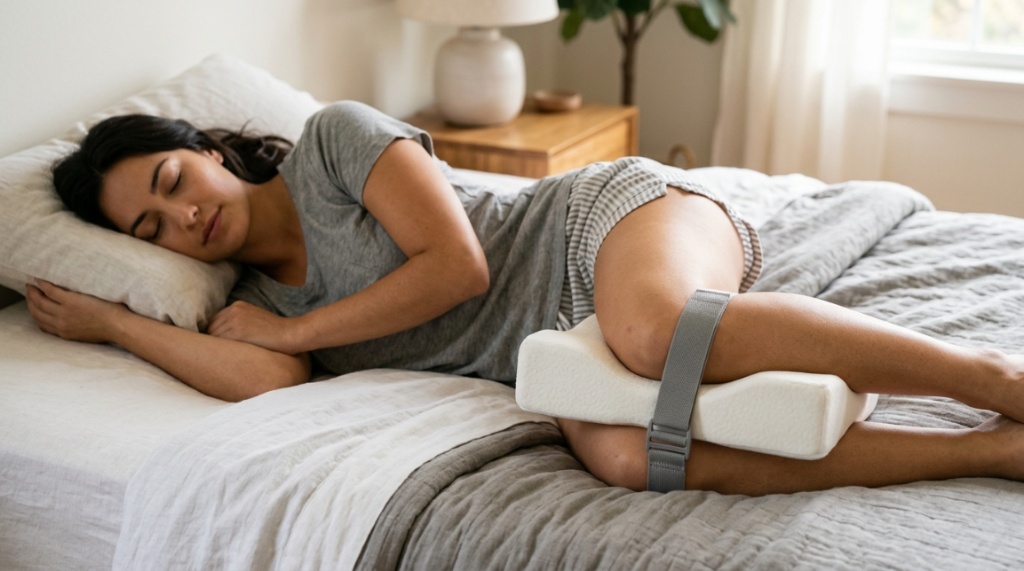
You wake up with that familiar ache in your hip or lower back. You know a knee pillow would help, but every affordable option you’ve tried ends up on the floor by 2 a.m. It’s frustrating. The problem isn’t that budget knee pillows are bad—it’s that most of us don’t know the specific design features that keep a pillow anchored between your legs all night. This guide will show you exactly what to look for in a budget knee pillow that actually stays put, so you can finally get restorative, pain-free sleep without spending a fortune.
What Makes a Knee Pillow Slip Off During the Night?
Understanding why your current pillow slides away is the first step toward solving the problem. Most slipping happens because of three core issues: the shape is too flat, the surface is too slippery, or the strap is poorly designed. A pillow that fails on any of these points will inevitably end up tangled in your sheets.
The Geometry Problem: Flat vs. Contoured Shapes
Standard rectangular pillows lack the anatomical curve needed to cradle your thighs. When you bend your knees, a flat pillow creates a pressure point that pushes it out from between your legs. Contoured options, which feature a slight dip in the middle and raised edges, conform to your leg’s natural shape, creating a secure friction fit. Look for a pillow with a visible “cradle” zone that matches the curve of your upper thigh.
Why Fabric Matters for Grip
Most cheap pillows use a smooth polyester cover that feels nice but offers zero traction. Your skin and pajamas create a slick interface, causing the pillow to slip when you shift position. A matte, brushed cotton or bamboo cover provides far more grip. Additionally, avoid silk or satin finishes on the contact surface. The friction between the fabric and your skin is what keeps the pillow in place.
The Role of Straps and Fasteners
If a pillow relies solely on leg shape, it will move. A strap is a game-changer. But not all straps are equal. Look for an adjustable, elastic strap that wraps around your thigh with a hook-and-loop closure. Fixed straps often bunch up or restrict circulation. An elastic strap that is roughly 1.5 to 2 inches wide distributes pressure evenly and prevents digging into your skin.
Which Contour Design Is Most Effective for Side Sleepers?
Side sleepers specifically need a pillow that maintains proper hip alignment. The ideal contour is one that keeps your top knee elevated to the same height as your hip. The most effective design for this is an “L-shaped” or “curved wedge” profile. These shapes lock the knee into place better than simple oval or rectangular foams.
Comparing “Hug” Style vs. Wedge Style
Hug-style pillows wrap around both thighs and have a band for your upper leg. They are excellent for aggressive movers. Wedge-style pillows have one flat side and one angled side. You place the flat side on the mattress and the angled side against your knee. For controlled, persistent sliding, wedge styles are more reliable. Hug styles are better for those who frequently switch sides.
How Thick Should the Contour Be?
Thickness determines alignment. If the pillow is too thin (under 3 inches), your hip tilts downward. Too thick (over 6 inches), and your spine bends upward. A 4-to-5-inch thickness is generally ideal for most adults. To test this, lie on your side and have someone check if your spine is perfectly parallel to the mattress. That measurement is your personal “goldilocks” zone.
Memory Foam vs. EVA Foam for Stability
Memory foam conforms but can soften and shift. EVA foam is firmer and more rigid, providing better structural support that resists movement. For a budget pillow that stays put, firm EVA foam is often the superior choice. It doesn’t compress as much under the weight of your leg, ensuring the contour maintains its shape and grip throughout the night.
How Tight Should a Knee Pillow Strap Be?
The strap tension is the difference between security and a tourniquet. It should be snug enough to hold the pillow against your thigh when you move, but never tight enough to leave a mark or cause numbness. A good test is the “two-finger rule”: you should be able to slip two fingers between the strap and your skin without force.
Adjustability Features to Look For
Your thigh circumference changes with weight fluctuations and even with hydration levels. An adjustable strap with multiple fastening points is essential. Avoid Velcro strips that only allow a single adjustment point. Look for straps that you can thread through a buckle or a loop design that lets you fine-tune the tension in small increments.
Where to Position the Strap
Placement is as important as tightness. The strap should sit at the midpoint of your thigh, not near the knee joint or the hip socket. Positioning it at the center of the quadriceps muscle ensures the pillow moves with you as a single unit. If the strap is too low, it will slide off when you flex your foot; too high, and it rides up your waist.
Signs Your Strap Is Too Loose
Waking up with the pillow rotated 90 degrees is a clear sign. Another indicator is finding the pillow between your ankles, not your knees. If you constantly have to re-adjust it in your sleep, the strap is not performing its basic function. Your body shouldn’t have to “work” to keep the pillow in place.
Can a Knee Pillow Stay Put Without a Strap?
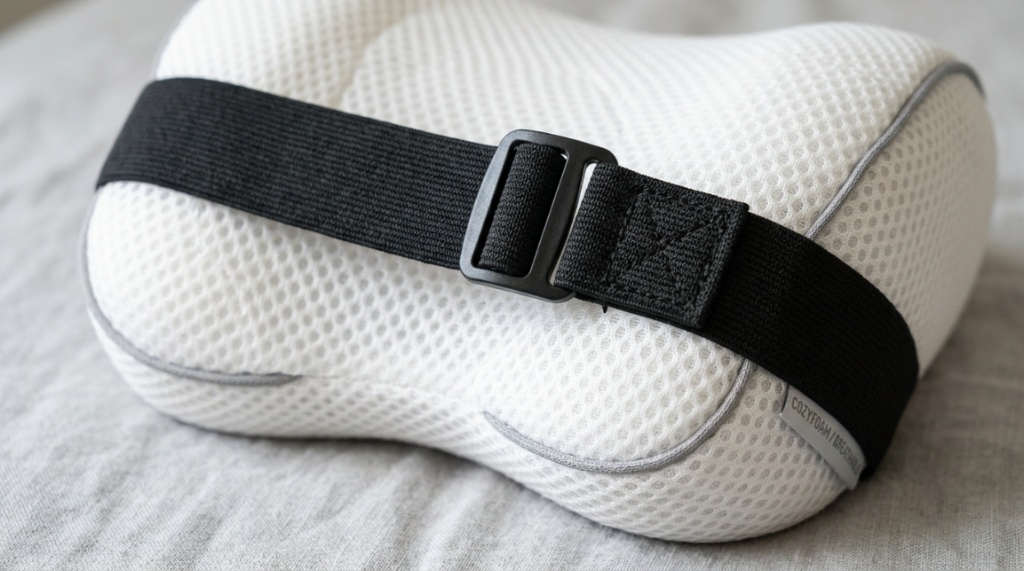
Yes, but only under specific conditions. Strap-less pillows rely entirely on friction and geometry. For this to work, the pillow must have an aggressive non-slip bottom layer (like a rubberized mesh) and a high side wall that acts as a buttress against your lower thigh. This works best on firm mattresses.
The “Non-Slip Base” Technology
Some premium budget pillows now include a separate non-slip base layer made of silicone dots or a waffle-textured rubber backing. This grips the bed sheet, while the top remains plush. If you’re buying a strap-less model, ensure the entire bottom surface has this texture. A smooth bottom on a firm mattress will slide with the first toss and turn.
When You Definitely Need a Strap
If you are a “rotisserie sleeper” who changes sides 10-15 times per night, you absolutely need a strap. Without it, the pillow will shift each time you rotate. Also, if you sleep on a softer mattress where the pillow can sink in and create a divot, the strap is necessary to hold it against your leg rather than letting it escape into the mattress crevice.
Testing Your Pillow Without a Strap
Before committing to a strap-less design, do a “shake test.” Hold the pillow between your knees and shake your legs vigorously for 30 seconds. If it stays put during the shake, it’s likely fine for lighter sleepers. If it starts to migrate after 10 seconds, you need a strapped version.
What Are the Best Budget Materials That Resist Slipping?
Budget doesn’t mean low quality. The key is to find materials that prioritize grip and durability over plushness. The outer cover and inner filler both play a role in traction. You want a combination that feels soft but behaves like a non-slip mat.
Cover Fabric: Cotton vs. Polyester Blends
100% cotton, particularly a brushed cotton or jersey knit, offers the best grip. It creates a static yet soft friction against skin. Polyester blends are smoother and more likely to slide. When reading product descriptions, look for terms like “matte finish” or “brushed” rather than “silky” or “smooth.” High thread count (above 300) also increases friction.
Filler Material: Shredded Foam vs. Solid Core
Shredded foam molds nicely but can shift inside the case, creating a moving target. A solid memory foam core or a solid EVA core is rigid, maintaining its shape and grip. Solid cores don’t create internal movement that destabilizes the pillow on the bed. If the pillow moves internally, the outer case will follow, leading to slipping.
The Importance of a Removable, Washable Cover
Over time, body oils and sweat reduce the fabric’s friction coefficient. A removable cover that you can wash regularly keeps the grip restored. Non-removable covers get slick after a few weeks of use. Always check the zipper quality—a cheap zipper that breaks ruins the entire pillow’s functionality.
How to Position a Knee Pillow for Maximum Stability
Correct positioning is at least 50% of the battle. Many people place the pillow too high or too low, making it unstable. The pillow should sit between your knees and upper thighs, not your calves or ankles. Your knee joint should be the pivot point,For those dealing with upper body discomfort alongside lower body alignment issues, pairing your setup with Affordable Orthopedic Pillows for Neck Pain can significantly improve your overall sleep posture.
The Alignment Check
Lie on your side with your knees bent at roughly 90 degrees. Place the pillow so that the top edge is near your hip joint and the bottom edge is just below your knee cap. Your two knees should be square to each other when viewed from above. Adjust the pillow until both femur bones (thigh bones) are parallel to the floor and stacked vertically.
Positioning Your Bottom Leg Correctly
Your bottom leg should be straight or slightly bent. Do not pull your bottom knee up toward your chest, as this tilts your pelvis. The pillow rests on the mattress beside your bottom leg. Make sure the pillow’s contour follows the angle of your top leg as it lies in a relaxed position.
Adjusting for Side-Switching Sleepers
If you switch sides, you need a pillow that works symmetrically. A one-sided strap is a problem. Choose a pillow that has the strap in the center or has straps on both sides. When you turn, you don’t want to have to re-thread the strap. Look for designs that are purely “direction agnostic” so you can flip without adjusting anything.
Are Expensive Knee Pillows Better at Staying Put?
Not necessarily. Expensive pillows often focus on luxury memory foam and cooling gel layers, but they rarely prioritize non-slip engineered bases. A budget knee pillow with a smart strap and firm EVA core will outlast and out-perform a $60 memory foam pillow with a slippery cotton cover. The price is not the determining factor for grip—design is.
Where Expensive Pillows Fail
Premium pillows often have “flowy” and soft covers that are comfortable but slide. They might also have plush, slow-recovery foam that conforms too deeply, causing your upper leg to sink and lose alignment. This sinking action creates a suction effect that pulls the pillow out of place. Expensive doesn’t automatically solve the physics of movement.
What the Budget Market Gets Right
Affordable brands are targeting the core utility of the product: keeping you aligned. They use simpler, more rigid structures and functional straps because they can’t rely on premium foam gimmicks. This necessity forces them to focus on the mechanical ankle of the design, which is exactly what “staying put” requires.
How to Judge Value Beyond Price
Evaluate the unit cost per year of usable life. A $15 pillow that lasts three years is better value than a $50 pillow that slides off every night and gets thrown away after a month in frustration. Judge the grip features first, then the price. A higher price for the same grip features is just a penalty, not an improvement.
When Should You Replace a Budget Knee Pillow?
Even the best budget pillow has a lifespan. The grip materials degrade with washing, and the foam loses its firmness. If you notice the pillow compresses to less than half its original thickness, or if the strap has lost its elastic recoil, it’s time to replace it. Continuing to use a degraded pillow causes misalignment and reopens the door to back pain.
Signs of Foam Fatigue
Firm foam should bounce back immediately when you press it. If it leaves an indentation that takes a few seconds to disappear, it’s exhausted. This softness creates instability because your leg sinks too far. The pillow essentially becomes a soft lump that can easily slide sideways.
When Velcro and Closures Wear Out
Velcro loses its “hook” after roughly 5,000 fastening cycles. If the strap unbuttons itself during the night, the pillow will relocate. You can clean the Velcro by picking out lint with a toothpick, but eventually, the hook side loses its grip entirely. Do not try to repair with safety pins—replace the pillow for your safety.
Can You Modify a Cheap Knee Pillow to Make It Stay Put?
Yes, you can use a few DIY tricks to enhance grip without buying a new pillow. These quick fixes will get you through until you purchase a dedicated model. They are also helpful for diagnosing which part of the pillow is failing.
The Non-Slip Rug Pad Hack
Cut a piece of non-slip rug gripper mat to the shape of the pillow’s base. Attach it with fabric glue to the bottom of the pillow. This adds the rubberized grip that the pillow lacks. This is a temporary fix, as the matting can bunch up, but it solves the slipping issue for a couple of weeks.
Using a Longer Strap (DIY Extension)
If your strap is too short and makes you insecure, you can buy a generic elastic strap and sew or clip it to the existing strap. Or, wrap a long piece of 2-inch wide elastic around your thigh, pass it through the pillow’s existing strap, and fasten with a safety pin. This gives you the adjustability you need.
The Real Solution: Buy the Right Tool
While DIY works, it’s rarely as comfortable as a purpose-built design. A proper pillow will have the grip built into the material, not added as an afterthought. Invest your $20 in a few weeks of testing rather than spending on unsafe DIY modifications that might involve hard plastic or metal clips.
How to Test a Knee Pillow’s Firmness in the Store or at Home
You can assess a knee pillow’s stability without opening the package, but the ‘touch test’ is supreme. When you receive it, there are a few key indicators of how well it will stay put. Trust these tactile tests over the marketing claims on the box.
The Compression Test
Press your thumb into the center. It should depress by about 0.5 inches and then resist. If it sinks 1.5 inches easily, it’s too soft. If it barely moves, it might be too hard and create a pressure sore. A 0.5-inch sink is the sweet spot that allows the foam to fill the gaps without losing structural integrity.
The Slip Test on Your Sheets
Place the pillow on your actual mattress and try to shove it horizontally. It should create a high level of resistance. If it glides like a hockey puck, you need a different cover. You can also rub the fabric against your pajama sleeve—it should feel slightly “grippy,” not smooth.
The “Sleep Lab” Evaluation Night
Don’t judge a pillow on the first night. Sleep on it for three consecutive nights to account for break-in stretch of the elastic strap. Measure the time it takes to shift. On night one, you might wake up once. On night three, you should sleep through. If it’s still sliding by night three, move on.
Frequently Asked Questions
Why does my knee pillow slide off every night?
Your pillow likely lacks a non-slip base, has a smooth cover, or the strap is positioned incorrectly. The most common cause is a slippery fabric cover and a soft filler that moves independently of your leg. Review the strap position and the fabric grip to resolve this.
Can I use a regular bed pillow instead of a dedicated knee pillow?
No. A standard bed pillow is too thick and spacious, making it unstable. It will not contour to your thigh shape, leading to misalignment and it will easily slip. The anatomy of a contoured wedge pillow is fundamental for knee stability.
Should my knee pillow be firm or soft?
Firm is always better for a knee pillow. A firm core distributes weight evenly and maintains its shape under pressure. Soft foam sinks, causing your top leg to tilt downward, which creates hip strain and encourages the pillow to slide laterally.
Is it better to have a strap or no strap?
A strap is better for everyone, but essential for restless sleepers. A strap rigidly couples the pillow to your leg, so it fundamentally cannot slide off unless the strap itself breaks. If you are a very still sleeper, a strap-less design with a non-slip base is acceptable.
Can I make a knee pillow stay put without buying a new one?
Yes. You can wrap a wide elastic band around the pillow and your leg, or you can glue a non-slip rug pad to the base. These fixes will improve grip, but they will not be as comfortable as a dedicated solution.
What if my leg gets numb with a strap?
Numbness means the strap is too tight or too narrow. Widen the strap to distribute pressure, and loosen it until you can fit two fingers under the fabric. Numbness is a sign of nerve compression, which you should never ignore.
Conclusion
Picking a budget knee pillow that stays put doesn’t require trial and error if you know the deciding factors. Focus on the geometry—a contoured shape that matches your thigh curve—and a firm core that won’t compress under weight. You need a fabric with grip, not silk, and an adjustable strap that you position at the midpoint of your thigh. Forget the price tag; a $20 pillow with a solid EVA core and a cotton cover will outperform a $60 luxury model with a slippery surface. Now that you know what to look for, you can confidently choose a pillow that will keep your spine aligned and relieve pressure all night long. Review the specific pillow specifications mentioned earlier and make your purchase tonight for better sleep tomorrow.