
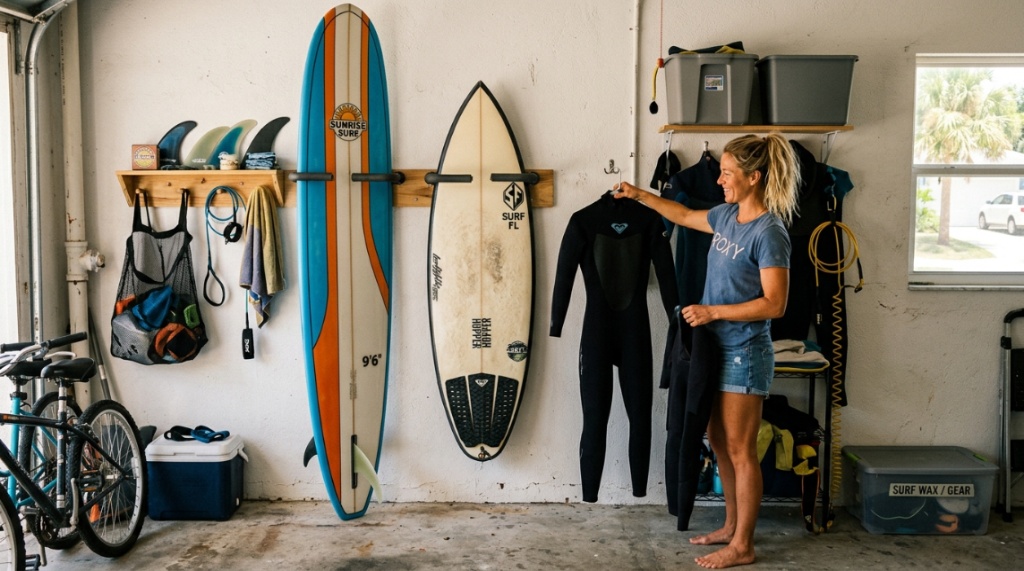
Florida’s heat, humidity, and intense sun can destroy a surfboard faster than any wipeout. Storing your board directly on the ground traps moisture underneath, leading to delamination and nasty mold spots. A wall rack solves this by keeping airflow constant and lifting your gear away from floor-level heat and pests. If you’ve been leaning boards against garage walls or tossing them in the corner, you’re already shortening their lifespan. Proper storage is the cheapest insurance you’ll ever buy for your quiver.
How Humidity Affects Foam and Fiberglass
High humidity seeps into the smallest nicks in your board’s glass job. Over time, moisture trapped inside expands and separates the foam from the outer shell. A wall-mounted rack prevents this by allowing air to circulate around the entire board. In Florida, leaving a board flat on concrete for just one week can start the rotting process.
The UV Damage You Can’t Reverse
Direct sunlight weakens resin and fades your artwork. Wall racks placed in shaded patios or garages protect your investment without you having to think about it. Even a few minutes of daily exposure adds up, especially during summer months when UV index levels peak in the afternoon.
Pest Problems Florida Surfers Forget About
Roaches, ants, and even lizards love dark spaces under boards left on the floor. Elevating your surfboard with a simple wall rack eliminates these hiding spots. It also keeps your board away from garage floor spills like oil, paint, or water stains from your car.
What Materials Hold Up Best in Florida’s Heat and Salt Air?
Not all wall racks are built to survive a Florida summer. Plastic racks can warp in direct heat, while basic steel racks rust fast when exposed to salt air. The best affordable surfboard wall racks Florida buyers should look for are made from powder-coated aluminum, UV-resistant polypropylene, or marine-grade stainless steel. These materials laugh at humidity and stay strong for years.
Powder-Coated Aluminum vs. Standard Steel
Standard steel might seem cheaper upfront, but after one hurricane season, rust appears. Aluminum with a powder coat resists corrosion and weighs less, making installation easier. It also doesn’t transfer heat as badly, so your board’s wax won’t melt onto the foam padding.
UV-Resistant Plastics That Won’t Crack
Cheap plastics become brittle after a few months in direct sunlight. Look for racks labeled “UV-stabilized” or made from HDPE (high-density polyethylene). These materials stay flexible and strong even when mounted on an outdoor lanai wall facing west, where afternoon heat is brutal.
Foam Padding Quality Matters More Than You Think
Some budget racks use thin foam that peels off within weeks. Florida’s humidity accelerates that peeling. Choose racks with thick, closed-cell EVA foam that won’t absorb moisture or turn into a sticky mess. This small detail keeps your board’s glossy finish scratch-free.
How Many Boards Do You Actually Need to Store?
Counting your quiver honestly prevents buying a rack that’s too small or one that wastes wall space. A single surfer with three boards needs a different setup than a family of four. Measure your board widths first. A 9-foot longboard is twice as heavy as a 5-foot shortboard, and your rack needs to handle that imbalance. Plan for one extra slot so you never have to wedge a wet board into a tight space.
Single Board Racks vs. Multi-Board Towers
Single racks give you flexibility to place boards anywhere, but they use more wall anchors. Multi-board towers save space and look cleaner but require stud placement that matches the rack spacing. For most Florida homes with standard 16-inch stud spacing, a three-board vertical rack works perfectly in a garage or screened porch.
Weight Capacity You Should Never Ignore
Longboards weigh anywhere from 12 to 20 pounds. If you stack three of them on a cheap rack rated for 30 pounds total, you’re inviting a crash. Always check per-arm weight limits, not just the total. A good budget rack holds at least 25 pounds per slot.
Accounting for Foamies and Soft Tops
Soft-top boards are thicker and heavier than hard boards. They also compress foam padding faster if the rack design uses narrow arms. Make sure your rack has wide arms or adjustable spacing to accommodate bulkier beginner boards without pinching the rails.
Which Wall Material Are You Mounting Into?
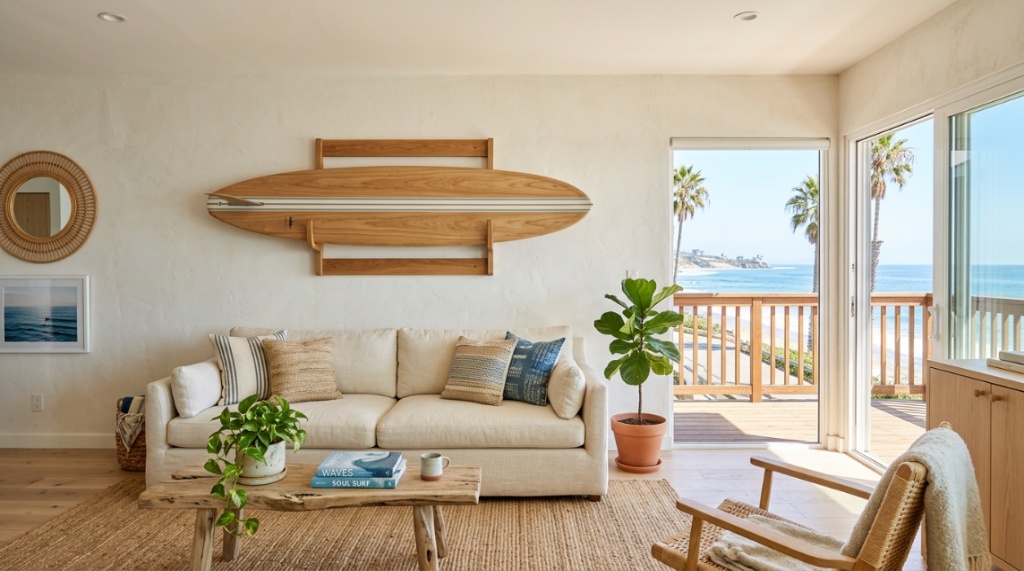
Florida homes have drywall, concrete block, stucco, or wood studs depending on the area. Garage walls are often drywall over open studs, while lanai walls are stucco over concrete. Each requires different anchors. A rack designed for drywall won’t hold in concrete block without the right hardware. Check your wall type before buying any rack.
Drywall Anchors That Actually Work
For garage drywall, use toggle bolts instead of plastic expansion anchors. Toggle bolts spread the load across a larger surface area and won’t pull out when you accidentally bump a board. This is the most common wall type in newer Florida developments, so it’s worth buying quality anchors separately even if the rack comes with cheap ones.
Concrete Block and Stucco Mounting Tips
Masonry walls require a hammer drill and Tapcon screws. Pre-drilling with a carbide bit prevents the stucco from cracking. A cordless hammer drill from a hardware store costs less than repairing a chipped wall. Many affordable surfboard wall racks Florida homeowners buy come with concrete anchors, but double-check the package before you start drilling.
Wood Studs Are the Easiest Mount
If you have exposed studs in a garage or shed, mounting is simple. Use 3-inch wood screws directly into the stud. No anchors needed. This is the strongest mount and supports even heavy quivers without sagging. A stud finder costs ten bucks and saves hours of headache.
Can You Install a Wall Rack Without Damaging Your Wall?
Yes, if you choose the right hardware and follow a clean process. Renting a home means you might want to remove the rack later and patch holes. Concrete block and stucco require drilling, but you can fill small holes with spackle or epoxy putty. Drywall anchors leave bigger holes, but repair kits are cheap and fast. The key is mounting into studs when possible, because that gives you the strongest hold with the smallest holes.
Step-by-Step Damage-Free Installation
- Locate studs with a stud finder and mark centers with a pencil.
- Hold the rack level against the wall and mark screw locations.
- Pre-drill pilot holes to avoid splitting wood or cracking stucco.
- Drive screws firmly but don’t over-tighten or you’ll strip the threads.
- Test each arm by pressing down with moderate force before loading boards.
Removable Adhesive Options for Light Loads
For foam boards or single shortboards, heavy-duty adhesive strips rated for 30 pounds can work on smooth painted drywall. These leave zero damage when removed. They are not reliable for glassed longboards or hot garages where adhesive softens. Use them only as a temporary solution in climate-controlled rooms.
What to Do About Uneven Walls
Florida homes settle over time, creating walls that are not perfectly flat. Use plastic shims behind the rack to level it before tightening screws. A crooked rack puts uneven pressure on your boards and can cause warping. Shims are cheap and available at any hardware store.
How Much Should You Spend on a Functional Wall Rack?
You do not need to spend more than $40 to $70 per unit for a durable, long-lasting rack in Florida. Anything under $20 often uses weak plastic or foam that degrades within months. Spending over $100 usually means you’re paying for brand name or extra features like integrated hooks for leashes. The sweet spot is a powder-coated aluminum or UV-stabilized plastic rack from a reputable surf gear brand that sells direct to consumers.Proper storage is essential for protecting your board from humidity and damage. Once you have secured your setup, don’t forget that transporting your gear requires equal care—check out our guide on How to Travel With Surfboard Fins Without Losing or Breaking Them to ensure your fins survive every trip.”
Hidden Costs of Cheap Racks
Buying a $15 rack might save money now, but replacing it every six months costs more in total. Cheap foam flakes off onto your board, and plastic arms snap when humidity weakens them. Good racks last three to five years or longer, making the upfront cost worthwhile.
Where to Find Deals on Quality Racks
Local surf shops in cities like Cocoa Beach, Jacksonville, and Tampa often have clearance racks. Online marketplaces offer bundled deals if you buy two or more units. Checking surf gear forums and Facebook Marketplace in Florida surf communities turns up barely used racks from people who downsized their quiver.
Warranty and Return Policies Matter
Florida’s environment is tougher on gear than most places. Look for racks with at least a one-year warranty against rust, cracking, or foam peeling. Some online retailers offer 30-day returns even after installation. Read the fine print before buying to avoid being stuck with a failing rack later.
Which Rack Style Fits Your Space Best?
Horizontal racks save width but require enough wall height. Vertical racks save space in narrow garages but need stronger mounting to handle leverage. Ceiling-mounted pulley systems work for tiny apartments but are harder to install. Measure your available wall space and door clearance before deciding. A rack that sticks out too far will get bumped every time you walk by.
Horizontal Racks for Easy Access
These hold boards parallel to the floor and let you grab any board without moving others. They are ideal for garages with wide walls. Most horizontal racks mount into studs and hold two to four boards. The arms tilt slightly upward to prevent boards from sliding off.
Vertical Racks for Tight Spaces
Vertical racks hold boards nose-up and use minimal wall width. They work perfectly in Florida’s narrow garages and storage sheds. The bottom of the board rests on a padded cradle while the top is secured with a strap. This style keeps boards visible and organized without taking up floor space.
Ceiling Hoists for High-Ceiling Garages
If your garage ceiling is over nine feet tall, a pulley system frees up all wall space. You pull a rope to raise the board to the ceiling. These are great for storing boards you use less often, like a longboard for small summer days. The rope and pulley mechanism must be stainless steel to resist rust.
Is It Worth Buying a Portable Rack for Renters?
Yes, because portable racks require no drilling and can move with you when you relocate. Freestanding racks that lean against the wall are perfect for apartments or condos where drilling into concrete is not allowed. They hold two to three boards and fold flat for storage. The trade-off is less stability, so they work best on carpet or non-slip flooring. In Florida’s concrete floor garages, add rubber feet to prevent sliding.
A-Frame Racks for Floor Storage
These are the most popular portable option. They hold boards on both sides of a central frame, creating a stable triangle shape. A-frames work well for soft tops and foamies because the wide cradles distribute weight evenly. They take up about two feet of floor space but require zero wall anchors.
Over-the-Door Hooks for Small Spaces
Over-the-door hooks rated for 20 pounds can hold a single shortboard or kid’s board. They damage nothing and install in seconds. Use them in laundry rooms, bedrooms, or indoor hallways. This works only for lightweight boards and doors with solid construction.
Freestanding Wall-Like Units
Some racks look like small bookcases with padded slots. They lean against the wall but do not attach. These units hold two to five boards and often have storage cubbies for fins, wax, and leashes. They cost more than wall racks but offer double the storage utility.
How to Maintain Your Wall Rack Year-Round in Florida
Even a quality rack needs occasional care in Florida’s climate. Salt spray from the beach settles on the rack and attracts moisture. Rinse the rack with fresh water every few months if it’s mounted outdoors. Check screws for loosening after storms. Replace foam padding if it gets compressed or starts peeling. Maintenance takes ten minutes but extends the rack’s life by years.
Cleaning Salt and Sand Buildup
Use a damp microfiber cloth to wipe down arms and padding. For stubborn salt crystals, mix a mild vinegar solution with water. Do not use bleach or harsh chemicals, as they degrade foam and powder coating. Dry the rack fully before storing boards again.
Inspecting Hardware After Storm Season
Hurricane-force winds can loosen wall anchors even if the rack seems fine. After a major storm, check every screw with a screwdriver. Tighten any that have backed out. Replace stripped anchors immediately. This simple check prevents boards from crashing down during the next high wind event.
Replacing Worn Foam Padding
Some racks sell replacement padding kits for under ten dollars. If the foam on your rack is cracking or crumbling, order new strips. Clean the arm surface with rubbing alcohol before applying the new padding. This restores the rack to like-new condition without buying a whole new unit.
Frequently Asked Questions
Can I mount a surfboard wall rack on stucco without special tools?
You need a hammer drill with a carbide-tipped masonry bit and Tapcon screws. Standard drills will not penetrate stucco and concrete block. It is a straightforward job but requires the correct tools.
How many boards can a single wall rack typically hold?
Most affordable wall racks hold two to five boards depending on the model. Check the per-slot weight rating. A three-board rack is the most common size for individual surfers and works well in Florida garages.
Will a wall rack damage the glassing on my surfboard?
Quality racks use soft EVA foam padding that will not scratch or dent fiberglass. Avoid racks without padding or those using hard plastic contact points. Check that the foam is securely glued and covers all rail contact areas.
Do I need to mount into studs for the rack to be safe?
Stud mounting is the strongest option and recommended for longboards or heavy quivers. Drywall anchors can work for lighter boards if you use heavy-duty toggle bolts. Never rely on plastic expansion anchors for boards over ten pounds.
Can I use a wall rack in an outdoor area like a screened porch?
Yes, but choose a rack made from UV-resistant materials and powder-coated aluminum. Standard plastic and steel will degrade quickly outdoors. Also, keep the rack protected from direct rain if possible.
What is the ideal height to mount a surfboard wall rack?
Mount the rack so that the lowest board hangs at least six inches off the floor. This prevents accidental kicks, pets, or water damage. For vertical racks, place the bottom cradle at waist height for easy lifting.
How do I prevent wax from melting onto the rack padding?
Store boards in a shaded, ventilated area. In Florida’s summer, never leave a board in a sealed metal storage shed. The interior temperature can exceed 140 degrees, melting wax and damaging the rack’s foam padding.
You Already Have the Gear, Now Protect It Properly
Choosing the right wall rack for your Florida home comes down to matching the material to your climate, the design to your wall type, and the capacity to your actual quiver. You do not need to overspend or overcomplicate the process. Focus on UV and humidity resistance, solid hardware, and reliable foam padding. A good rack pays for itself by preventing expensive repairs and board replacement. Measure your wall today, check your stud spacing, and pick a rack that fits both your space and your budget. Your boards will ride better and last longer when they sleep off the ground.